
Much of my life has been spent in search of the perfect church. There is no such thing, of course, but even so, I have come quite close three times: Once was in Greece, with its byzantine basilicas designed to transport the worshiper straight to heaven. Another time was in Mexico, with its five or more beautiful churches per capita. And the third was in Wales, where I met a priest with the extraordinary ability to turn himself into a stained glass window onto the divine.
I did not find the perfect church in the commercialized churches of Italy. (“Pop your Euro in the slot and a fake electrified candle will shine brightly for at least two minutes”). Far less did I find it in the often padlocked churches of New Zealand and the United Kingdom.
But now I am in Argentina. And here follow two unrelated accounts of my ongoing quest for the perfect church.
Soldiers in the Cathedral
I visited Buenos Aires Cathedral during my very first week in Argentina. I was somewhat shell-shocked at the time, because that is what Buenos Aires does to newcomers not yet acclimatized to the glorious madness. So it is worth noting as an aside that what struck me as borderline bonkers then would probably not even cause my eyebrows to twitch were I to encounter it today, given my newly-acquired understanding of what constitutes normal.
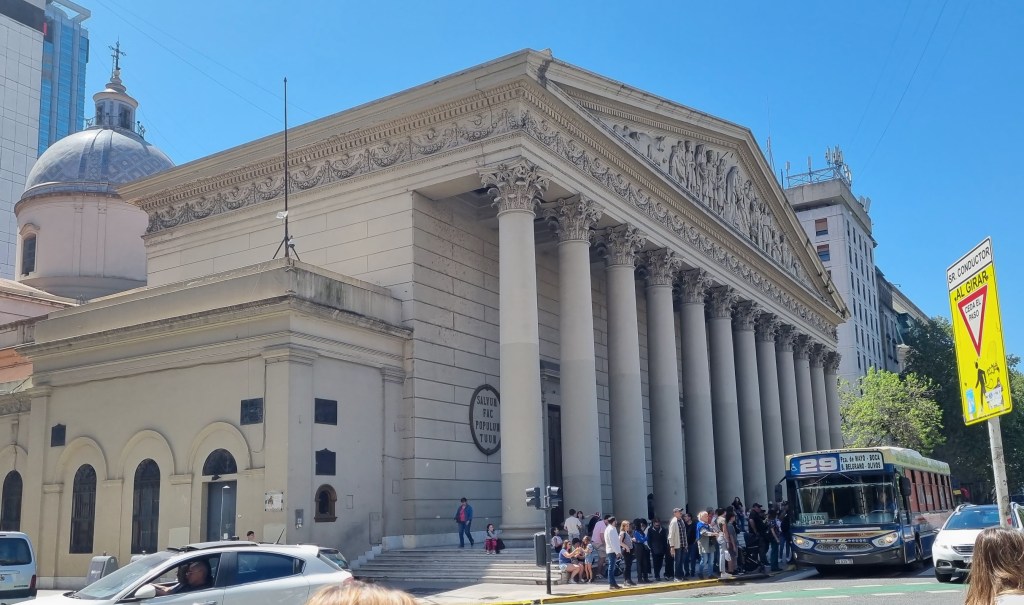
In spite of being absolutely enormous, and in spite of being prominently located in Plaza de Mayo, the iconic central square of Buenos Aires, the cathedral is surprisingly difficult to find (I am not the first to note this). This is because it is unexpectedly concealed behind a very civic-municipal facade. From the outside it looks for all the world like a City Hall or a Court of Law. I circumnavigated it several times, convinced Google Maps was telling me fibs, before it dawned on me that this imposing edifice was not the place of government business it appeared to be, but the very building I was looking for.
Built over the course of a century and officially instituted in 1852, Buenos Aires Cathedral (where the current pope served as Archbishop before moving to the Vatican in 2013), boasts a classical Greek-style portico, which Wikipedia informs me is a replica of the facade of Paris’s Palais Bourbon. The twelve pillars out front are meant to represent the twelve Apostles, and the frieze on the pediment above depicts Joseph’s reunion with his father and brothers. This scene was deliberately chosen to symbolize the unity of the Argentine nation in the aftermath of several unpleasant civil wars, apparently. (Absolutely everything is political here.)
The exterior is highly misleading though. For the moment you step inside, City Hall transforms into a vastly different kind of building: a cathedral in the traditional style, with great gothic height, five naves, multiple side-chapels, a celestial dome, and lavish furnishings and statuary.

But then comes another moment of profound cognitive dissonance, at least for me: And it comes in the form of a side chapel dominated by an enormous marble pedestal, topped with a giant sarcophagus over which is draped the blue and white striped flag of Argentina.
Here lie the remains of General Jose de San Martin (1778-1850), flanked by three gigantic female figures representing Argentina, Chile and Peru, the nations he liberated from Spanish colonial rule back in the 1800s.
But that is not the surprise, for cathedrals often have side chapels, and many of them house tombs. What evokes the dissonance is those two unmoving, unblinking, po-faced Buckingham-palace style guards from the Regiment of Horse Grenadiers, one on either side of the chapel entrance, both armed with rifles.
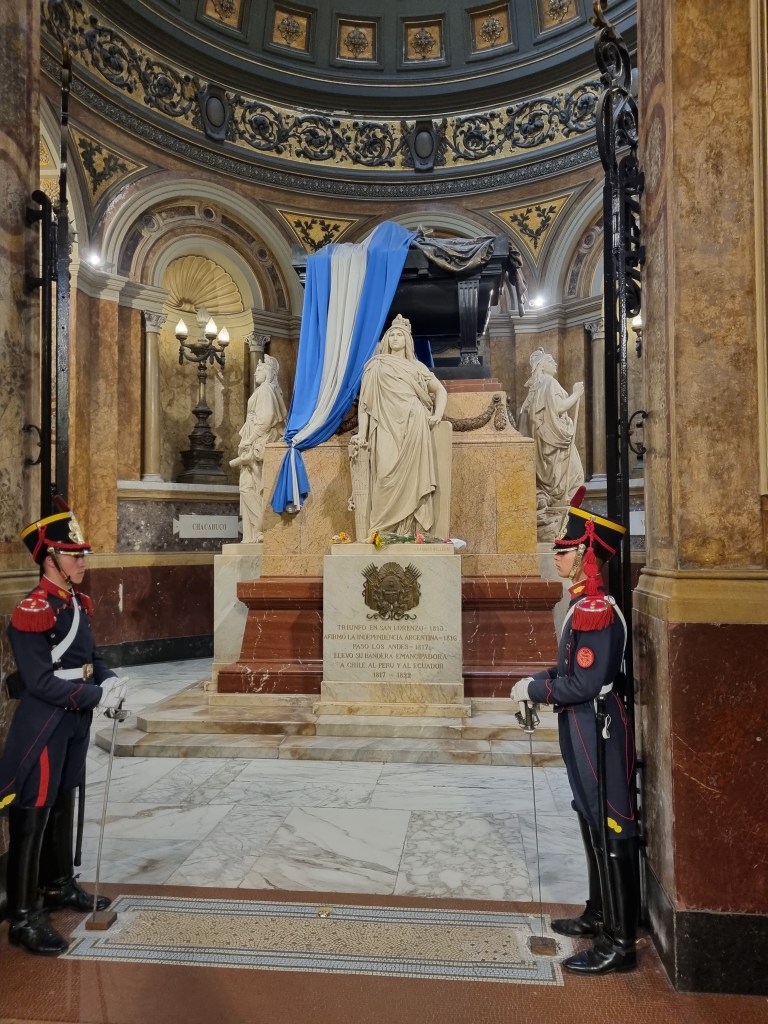
The last thing I expected to see was soldiers in the cathedral. An absolute first for me, and I have visited quite a few cathedrals in my time.
So many questions! Vatican City has its Swiss Guard, but what other countries have armed soldiers watching over the remains of dead heroes in their cathedrals? What are they guarding against? Why do they need rifles? And while it is hard to imagine a band of sarcophagus robbers coming to whisk away the General’s remains, are the rifles loaded, just in case? Do they stay there all night? Or does the General spend the wee small hours attended only by God and the Liberated Ladies of Argentina, Peru and Chile?
The Blind Man’s Serenade
And now for something completely different. Days that find me walking the early morning streets to attend 8 a.m. mass in the most beautiful church in Buenos Aires are always good days, even though my walk takes me past doorways where the forms of the still-sleeping homeless create tragic bumps under inadequate blankets. For it is winter here and the nights are bitterly cold. At the same time, the pavements are thronged with people rushing off to work, early dog walkers, and parents taking their children to school. At least a dozen of the people I pass meet my eye and say “Hola! Buen dia!” That would never happen in London, or even in Auckland, or many other places I could think of. But here in Buenos Aires, people recognize the existence of others, even complete strangers, and they do it as a matter of course, because that is what they are like.
I reach the towering wall that surrounds Recoleta Cemetery, over which the spires and statues that top the family tombs of Argentina’s rich and famous loom. (Eva Peron is here, among others.) Across the road, and in jarring contrast, is a modern monstrosity called Recoleta Urban Mall, which I haven’t visited yet, and probably never will. Then I turn the corner, walk past the still-locked gates of the cemetery, and arrive at my destination: the basilica of Our Lady of Pilar.

Julio, a blind man, sits on his stool outside. He is there most mornings, weather permitting, seeking alms from the early churchgoers, unintentionally separating the sheep from the goats. He knows my voice, and yesterday he asked me what color the sky was (it was grey) before unexpectedly breaking into a serenade, a song with the title “Margarita.”
Another absolute first. But then Buenos Aires offers up absolute firsts every day. It is fast reaching the point where the day Buenos Aires does not offer up an absolute first will be an absolute first in itself. I have no words to express the way that serenade made me feel, except to say it could only ever happen here, in Buenos Aires.
The church is one of the oldest in the city. An elegant whitewashed exterior opens into a sumptuously decorated interior that still preserves the original baroque altarpieces, wooden furnishings, statuary and paintings that date back to the 1730s.

I take a pew towards the back and allow the peace of the pre-mass quiet to wash over me. When it begins, it is of course in Spanish. This I consider a perfection, although I am aware my reasons for thinking so do not redound to my credit. For while I love many aspects of church services, I have always found the sermon tends to bring out the critical worst in me. And it really isn’t a good thing to be sitting in a church thinking critical thoughts.
But oh how a Spanish sermon transcends all that! For me at least, a sermon in Spanish is a perfection of a sermon! And this because I generally understand no more than half of it.
So, I might hear something like this: “Forgive us our sins [unintelligible Spanish]…… mercy, faith [more unintelligible Spanish] ….. the grace of God ……Our Lord Jesus Christ ….let us give thanks to him [yet more unintelligible Spanish] …… blessings ….. transformation ……Holy Spirit…. new life ….. [finale in unintelligible Spanish]…. Amen.”
It is perfect, simply perfect. Just keywords and the freedom to fill in the gaps. So while I am listening to the same sermon as everyone else, I am almost certainly not hearing the same sermon as everyone else. Perhaps I am hearing the perfect sermon – a bit like those gathered in an upper room in Jerusalem on the day of Pentecost heard precisely what they needed to hear thanks to a mystery that went beyond the barriers of language.
When I finally become fluent in Spanish and can understand everything, I think I will look back with nostalgia on the days I got to hear sermons that transcended language. It is different with the Bible readings and the liturgy, though, because I am familiar with the English versions of both. Still, even here there is room for spiritual flight, for the sort of transcendence I would never experience were it all in boringly comprehensible English.
There are other perfections. The service is short for one thing, just half an hour. And there are no hymns, just simple sung responses. Then there is the impersonal nature of the entire event, for the congregation is made up of a small core of regulars and a passing parade of visitors, tourists mostly, here today and gone tomorrow. This means no-one wants to get to know me. No-one pounces on me and asks me to fill in a contact card so they can track me down and pester me later. No-one follows me home like the Quakers once did in New Zealand. No-one asks me to stand up and introduce myself to the congregation, as happened once in an Anglican church to which I naturally never returned. No-one takes any notice of me, and that is just the way I like church to be.
So I go back to the most beautiful church in Buenos Aires, and I keep going back. It is Catholic, of course, which I am not. There is some irony in finding a perfect church in a denomination with which I have had considerable issues in the past, and which has many doctrines with which I remain largely unreconciled. I expect I will iron out these wrinkles in due course. But in the meanwhile, everything is in Spanish, and so all I would otherwise find objectionable simply flies clear over my head, and the only thing I experience is the pure transcendence of the perfect church.

 Letters from Buenos Aires
Leave a Reply