It was an Argentine who welcomed me thus to Buenos Aires. The analogy made me laugh, for there is certainly some supporting evidence. (I personally think that the glorious madness of Buenos Aires has to do with Spanish people historically marrying Italian people and producing Argentinian people. The result is not unlike what happens when you mix bicarbonate of soda with vinegar.)
To illustrate, I offer you a short video taken the moment Argentina won the Copa America (soccer, of course) and the entire city exploded with joy. I took this video from the balcony of my apartment in the asylum, and the uproar comes not from the street below, but from the various apartments all around.
The word asylum has more than one meaning though, and it is the second that has lately absorbed my attention.
“We are Considering Issuing a Warrant for Your Arrest”

Troubles, as Shakespeare said, do not come as single spies, but as whole battalions. And so, after an advance guard in the form of a troublesome client, I was not surprised to encounter the battalion. It arrived the moment I swapped the sim cards in my phone: the New Zealand one for the Argentine. I rarely do this, because I have little need to, and because I am reluctant to release into my phone a platoon of unwanted messages from my past life. The battalion had thus lurked on my unused New Zealand sim for months, just waiting for the order to invade.
It took the form of a dozen or so messages from New Zealand’s Ministry of Justice, demanding with escalating imperiousness that I call them (although not saying why), before culminating in the following terrible pronouncement: “We are considering issuing a warrant for your arrest.”
¿Que?
I entertained the brief hope it was just a scam, a bit like those emails that pretend to be from your bank and try to get you to give up all your personal information. But no. It was not a scam. It was far worse: it was legitimate. I was to ring the Fines Enforcement Department at New Zealand’s Ministry of Justice at once or I would be in handcuffs.
There were two immediate problems. The first was that I had no idea of the nature of my crime. The second was the impossibility of complying with the demand, as I am yet to discover how to make international calls from Argentina. This shouldn’t be difficult, but it is.
Feeling a panic attack coming on, I rang my son. He thought it sounded traffic-related and asked me if I’d left any unpaid traffic fines in my wake.
“Of course not!” I said. But even as the words left my mouth a horrible little bell started clanging in that crowded room in my mind where everything I would prefer to forget is stowed.
I had been driving into town a few weeks before leaving for Argentina, stressed and not a little distracted. To get into town – a small town in New Zealand – I had to pass through a zone where the rural speed limit of 100 kmh falls to 70, before dropping again to 50 a kilometer or so further on. In this happiest of hunting grounds, the traffic police secrete themselves daily, for here they enjoy enormous success. I had passed safely through this trap a thousand times, but not this day. I slowed too late. The police car slipped out of its hiding place, siren blaring, lights flashing, and I pulled over with a sinking heart.
The Dog Ate My Homework
In those flurried last weeks in New Zealand I forgot all about it. Presumably the ticket arrived in the post after I left, and so there were no physical reminders. Lost to sight, the matter was lost also to mind. But now, a year later, I was confronted with the news I was about to become a Fugitive from the Law, a Wanted Woman, someone who would be Arrested at the Airport, should she ever return to New Zealand.
I managed to find an email address for the Fines Dispute Department (a workplace no doubt every bit as much fun as the Fines Enforcement Department), explained just how it was the dog ate my homework, and asked how much I owed them. There was one consolation while I awaited my fate: If I were too late to prevent the arrest warrant, I would at least be in Argentina, a country where far worse offenders than me have found asylum.
“Whatever you Do, Don’t Mention the War”
All this brings me full circle to that welcome I received to “the asylum.” For this little crisis got me thinking about that other meaning of the word. I had not expected this second meaning to acquire personal significance, for I had not anticipated becoming a Wanted Woman. But this being the case, what better place to be Wanted than in Argentina?
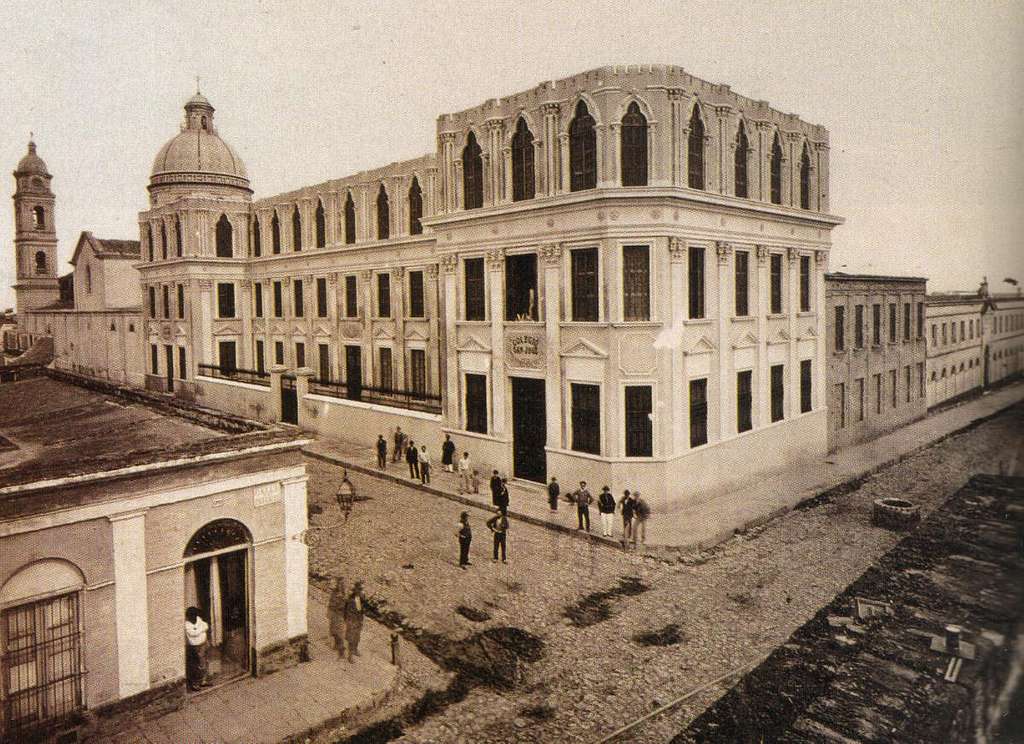
For offering asylum to both the deserving and the undeserving is part of Argentina’s national history. And while I cannot hope to do justice to this extremely complex history, and while there is much about which I am entirely ignorant, the basic outline is as follows:
Three and a half million Italians arrived between the 1850s and the 1950s. And in the 1930s, when many other countries were refusing them entry, Argentina provided refuge to tens of thousands of Jews fleeing Europe. In the 1940s, Argentina again became home to thousands of Jewish holocaust survivors.
In the twentieth century, significant numbers of Asian migrants arrived, and now, in the twenty-first, there is a growing population of Russians, north Americans, Europeans and, and others – retirees, digital nomads, and asylum seekers of one kind or another for various personal reasons – of whose number I am one.
I would be remiss, though, if I did not acknowledge that Argentina, like God, is merciful to both the righteous and the unrighteous, and that there have been some highly undeserving beneficiaries of this open door policy. Nazi war criminals spring to mind. Here I am going to ignore the advice of the inimitable John Cleese, playing Basil Fawlty in an unforgettable episode of Fawlty Towers, when he said: “Whatever you do, don’t mention the war.” (If you haven’t seen it, it is very funny and I have provided a link below.)
Germany on Steroids
To return to the Nazi war criminals, some eight hours by road from Buenos Aires there is a strange little town called Villa General Belgrano, which effortlessly embodies both meanings of the word “asylum.” Concerning the first, the place looks for all the world as if it has been transported from Germany lock, stock and giant beer barrel. With its Bavarian architecture, wooden statues of mädchen in traditional German dress, and its very own Oktoberfest, Villa General Belgrano is Germany on steroids.

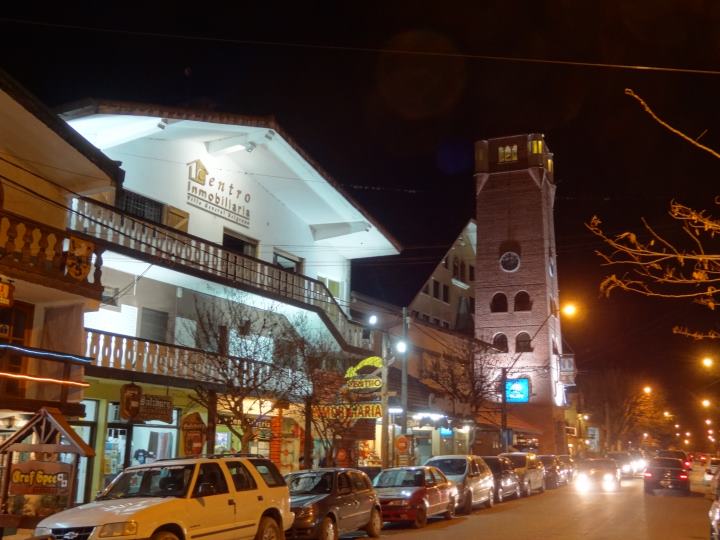
Tourists flock to enjoy its charming madness in the middle of Argentina, especially during Oktoberfest. Founded in the 1930s by a couple of Germans, the settlement grew after the Battle of the River Plate and the arrival of a group of scuttled German sailors.
Concerning the second, and more notoriously, when Argentina became something of an asylum for Nazis in the 1940s, a wave of serious war criminals arrived in the country, many of whom settled in this town. (There’s even a hotly contested legend that Hitler didn’t die in a bunker in Berlin, but fled instead to Argentina, where he holed up until his death in 1962, as the linked article in The Guardian explains.)
All’s Well that Ends Well (Sort Of)
And so what of my own soon-to-be-criminal status? I did not have to wait long to find out. I heard back from New Zealand’s department of unpaid fines with unprecedented speed. It is astonishing how quickly government departments respond to inquiries when there is money involved.
They had gone ahead and issued the warrant for my arrest, they said, but if I paid my outstanding fine of $110 NZ (about $70 US) immediately, the warrant would be withdrawn. I could not help wondering, as I made the payment, if issuing an arrest warrant over a forgotten fine of $70 US isn’t just a teeny bit extreme, or possibly even borderline lunacy. But I am hardly a qualified judge of these matters, especially as a resident of the glorious asylum, which, after a full year, I now fondly think of in terms of the second, and not the first sense of the word.
 Letters from Buenos Aires
Leave a Reply