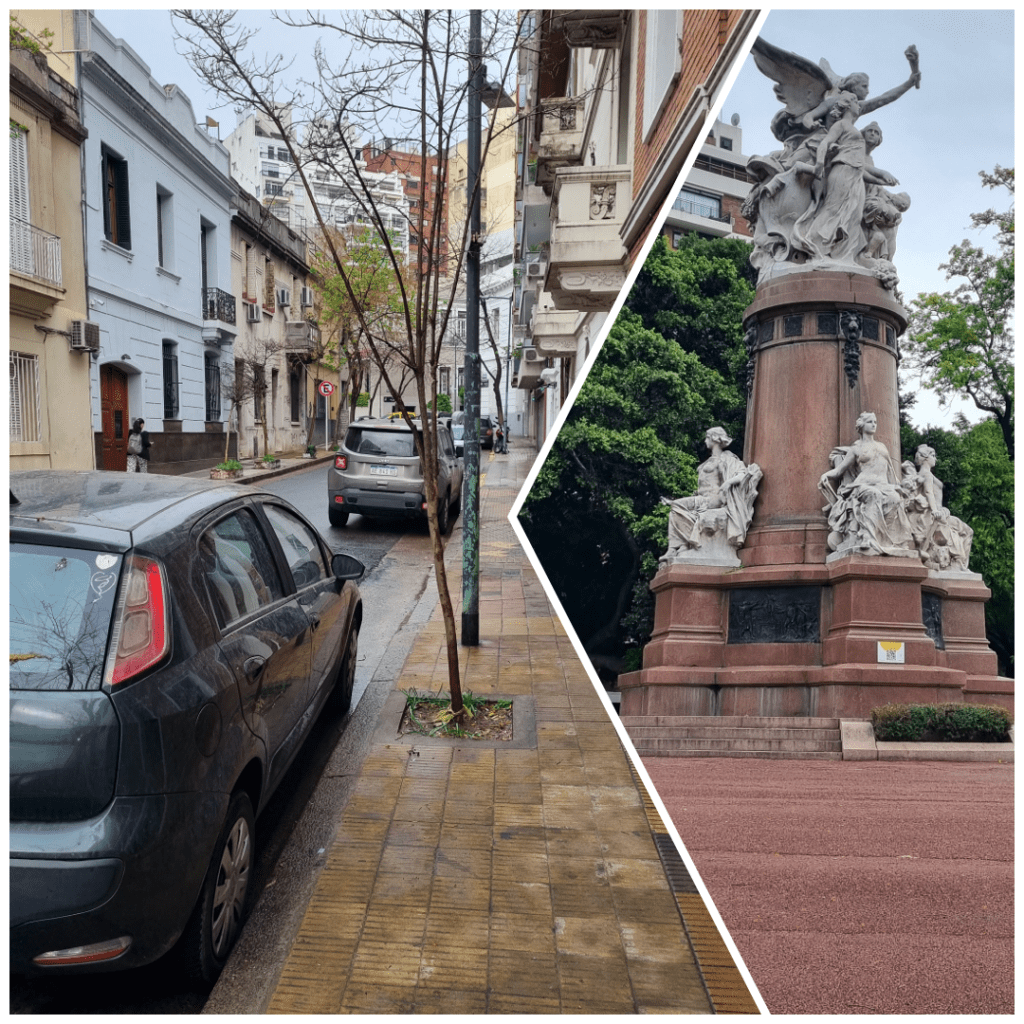
On Saturdays, the toilet cistern in my apartment refuses to refill itself. It doesn’t care much for doing so on Sundays and Mondays either, although it does oblige Tuesdays through Fridays.
There is probably a perfectly logical explanation for this – I just haven’t figured it out yet. I have sometimes wondered if there is a connection between the periodic banging about and whistling on the roof above my apartment and the cistern springing back to life, but I cannot be sure. This could just be me imposing my foreign logic upon a city that in its radical otherness is not, and never will be, subject to the narrow framework of thought I happened to bring with me to Argentina.
In my previous apartment, matters were worse. The cistern would randomly start overflowing, spewing water all over the place, usually at times when it was unsupervised. I became aware of this when I saw water flowing into the living room through the light fittings from the mezzanine floor above. This struck me as not merely bad, but downright dangerous.
Then there was the ancient gas boiler, which had a ladylike aversion to thunderstorms. At the first rumble of thunder (of which there is plenty in Buenos Aires), it would turn itself off and refuse to start again for at least twenty-four hours. A toilet cistern that merely goes off duty for the weekend offers little reason for complaint after all that.
It must be admitted, though, that I was entirely unprepared for the reality of Buenos Aires, that otherness that hit me like a steam train the night I arrived, and that continued to do so over the many strangely sleepless days and nights that followed. I attribute this sleeplessness to a certain charge in the air, which I seemed to absorb by osmosis, although charge is an inadequate word. It was more like an electric shock. I feel it still. I think it is called being alive.
The Magic Blue Sube Card
Anyway, sleep deprived, jet-lagged, and super-charged all at the same time, basically just as high as a kite on the energy of the place, I wandered up and down the cobbled streets of my neighborhood, trying to take it all in, trying to adjust to this new reality and the knowledge that nothing would ever be the same again, and, while I was about it, trying to procure the “Sube” card that would allow me to use the public transport system.
Buenos Aires has a wonderful public transport system, the legacy of more prosperous times, for back in the day Argentina was one of the six wealthiest nations in the world. There is an excellent underground subway and an equally excellent above-ground bus network. There is a problem, though. To access this marvel, you need a magic card, a rechargeable blue magic Sube card. Only the magic card will suffice. You can’t use cash to ride the buses or the underground.
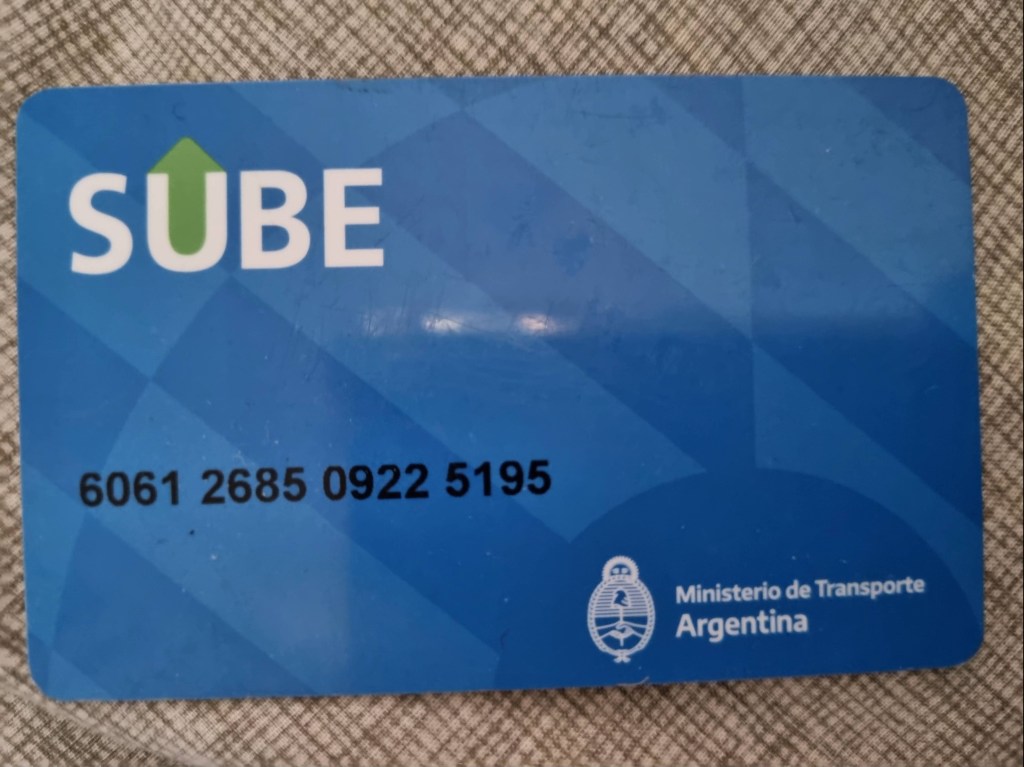
Herein lies the problem, for the magic card cannot be had for love or money. All the local kioskos (corner shops) have prominent blue Sube signs in their windows, but as I quickly discovered, this does not mean you can actually buy one there. You can only recharge your existing card. It took three days of walking round in a daze to find one, which I eventually did in a small kiosko with a sign in the window triumphantly proclaiming: “We have Sube Cards!”
This shortage of Sube cards remains a mystery to me (why don’t they just make more of them?) but then so too do many aspects of this city and its people. It has become a sort of puzzle to solve, one that brings me constantly crashing into the limits of my framework for understanding how things work, how things ought to work, and how things actually do work, against all the odds.
Because everything, absolutely everything, works differently here. I find myself having to re-learn how to live almost from scratch. It is as if I have woken to find myself a character in a video game of enormous complexity. Let us call this game Surviving Buenos Aires. At the same time it is as if I have woken from a dream to find I have become a child again, dependent on the kindness of strangers for the simplest things. (Fortunately the strangers here are mostly very kind.)
Even now, months down the track, I am not over the shock of it all. For I come from a world where most of the time and in most places things function in ways you might expect, although, as a corollary of that, where everyone is born already old. Here in Buenos Aires, things do work, just not in ways you might expect.
Things work in a perfectly imperfect symphony of duct tape, chewing gum, pragmatism and prayer. And it is this perfectly imperfect symphony that appears to hold Buenos Aires together.
The Storm
It was the aftermath of the storm of December 17 last year that revealed this fact most clearly. It was so bad, all people now need to say is “the storm” and everyone knows at once which storm is being referenced, even though Buenos Aires is no stranger to storms. The storm woke me in the night. The shutters on the windows were banging violently, and the trees in the courtyard were bending alarmingly, although they survived unbroken. The trees on the street were not so fortunate. A lot of them came down that night, along with walls, and most tragically, the roof of a stadium that killed thirteen people. But it was mostly the trees, and as they fell, they brought down everything in their path, power lines in particular, before finishing their downward trajectory on the roofs of instantly-crumpled parked cars.
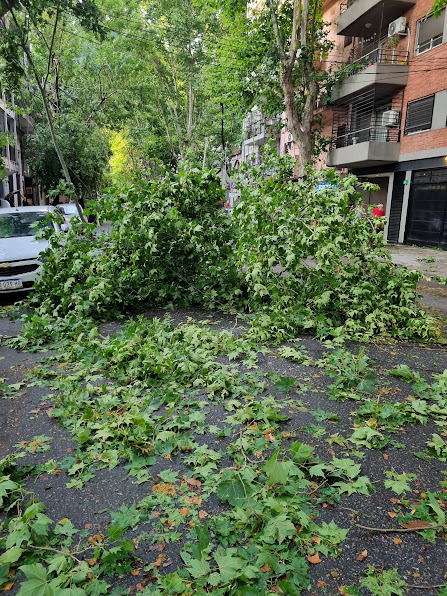
The following morning I got to see the Argentinian approach to disaster in action. There were workmen everywhere, armed with duct tape, chewing gum, chain saws, and rolls of wire. There were men on ladders up poles bare-handedly tossing dangerous-looking cables onto people’s balconies and reattaching internet and power lines with tape, and sometimes, as in the case of my son’s apartment building, roping residents in to catch the cables.
Conspicuous by their absence were the fluorescent safety jackets, helmets, cordons, danger signs, and officious-looking men with clipboards ticking boxes confirming three thousand and one health and safety protocols were being adhered to. It was clearly no time for protocol. It was a fix-it-as-quickly-as-possible situation. But at least this meant Buenos Aires was up and running again in no time.
It is an approach that one local calls “normalized insufficiency.” “There’s something very curious about this Porteño society in Argentina,” she says. “There’s a generalized negligence. . . . like a pride in doing things by halves, half-solving them in the short or very medium term. It’s like a pride that arises from something that is partially operative but highly risky.”
I know what she means. Everything that wasn’t urgent just got left. A significant time lag then developed between basic functionality and everything being truly back to normal. There were piles of fallen tree trunks lying about everywhere months later.
Yet at the risk of romanticizing, I find the underlying patch-it-up pragmatism refreshing, rendered so by contrast with the culture from which I hail, with its legislated safety standards, its rules and regulations governing the construction and maintenance of absolutely everything, its safety clipboards, and its kilometers of “Danger, Keep Out” tape.
But to return to the temperamental cistern, today, being Saturday, I need to warn my son and his girlfriend about it when they come for lunch. They will roll their eyes when I mention the need to flush the loo with a bucket should they need to use the bathroom. I suspect they will not believe me when I assure them, as I did last weekend, that it only happens at weekends, and is perfectly fine during the week. Still, their cistern isn’t exactly perfect, so they really don’t have any cause for eye rolling. Their cistern requires manual unjamming after each use, otherwise it just settles into perpetual flushing mode.
It is at this point, confronted by things that don’t work, things that cannot be obtained, all the many unexpected problems negotiating Buenos Aires, that the resident alien might be tempted to make black and white comparisons between a city where nothing works as it should and a city that functions like a finely-tuned watch. My son’s girlfriend, born and raised here in Buenos Aires, says she cannot imagine what it would be like to live in a place where everything runs like clockwork.
My rejoinder to this is that the people just wouldn’t be the same. They’d be Germans or Austrians or New Zealanders or something, and not Porteños, and that wouldn’t be nearly as much fun. At least not for me.
At the end of the day it is an approach that resonates with me. Maybe it is because I have never related to places that work like clockwork, or to people who work like clockwork, or to the need to work like clockwork. Maybe it is because much of my own life feels, and has always felt, as if it too were held together with duct tape, chewing gum, and a prayer.


 Letters from Buenos Aires
Leave a reply to Val G Cancel reply